Sunday, July 10, 2011

This Isn't Florida

Here is a sign we won't find in Florida.


We were riding in the taxi from the Columbus, Ohio airport to our hotel, when we passed this sight beside the interstate.


There was a bulldozer working on the very top. I commented that it looked so dangerous as the sand could shift and slide. The taxi driver politely informed me that it was not sand, but salt used for icy winter roads.

Guess I had showed myself as the Florida girl I am!

Saturday, July 9, 2011

Un-Locking the Past

We were shown the latest  project at The Works museum.

Here is the artist's rendition of what it looked like when the lock was in operation. 


There was a bell hanging out for the boatman to ring to call the lock operator, who lived in the red house on the right in the mural. The house still stands today.

Friday, July 8, 2011

Hot and Cold at the Works

We went to a museum in Newark, Ohio, called The Works: Ohio Center for History, Art and Technology. It is a cool little place with lots to see.

We were there because a family member had donated some personal items that are on display in an exhibit on Pure Oil, whose founder lived in the area.


My sister and I had the best time playing in a heat detecting camera exhibit. We found it pretty hilarious to see where the hot and cold spots showed up.


I have to say, it brings to mind the saying, "cold as a witch's ......!"
But, also the term, "hot lips."

Here is a shot of B and me.
Aren't we just too cool? Or is that warm?

Thursday, July 7, 2011

The Topiary Garden in Columbus

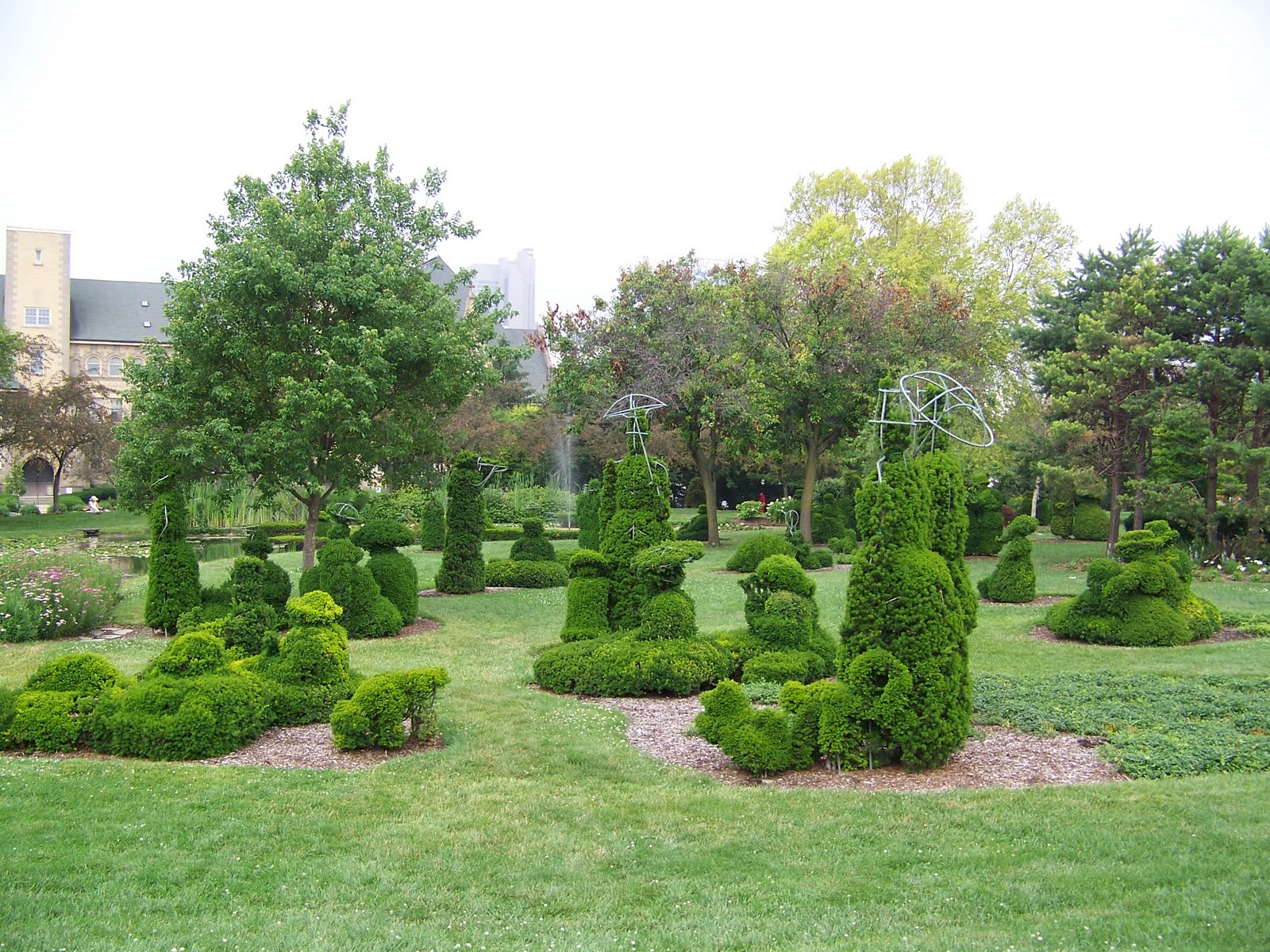
We recently spent a fun Sunday morning seeing a Sunday Afternoon. Let me explain: You may recall the famous painting, A Sunday Afternoon on the Isle of La Grand Jatte, by Georges Seurat,  that introduced the technique of pointillism, where color is applied in tiny dots to create a picture.


In Columbus, Ohio, we visited the topiary garden where living plants have been growing on wire supports to create this same scene since 1992.


The topiaries are larger than life: the tallest is 12 feet tall.


Below is the character description.

It was fun to walk into the garden to be with the characters and have them all around you. I had an umbrella and we used it as a parasol to pose with the topiary folks. (For family only, I will show you the one where I was the monkey and my sister was the lady with the parasol!)


A pond was built to serve as the Seine River. Looking carefully at the picture above, you can make out the boats on the water.

It was starting to rain. I think there is a wet spot on the lens in the picture below.


This is taken from across the pond.


What a neat place!

Wednesday, July 6, 2011

Bella Moth: Pretty Poison


Bella moth, Utetheisa ornatrix, truly is a beautiful moth, as "bella" suggests. We came across this one and,  the following  day, we saw it again (or another) in our vegetable garden. In my research to identify this moth, I learned that it is intricately intertwined with the the plant Crotalaria, commonly called rattlebox for the sounds the seeds make in the dried pods. There are plenty of rattlebox plants growing in the fields surrounding our garden, but this Bella moth was on a zinnia. It is not one of the larger flowers : that this is a rather small moth. Bella moths are diurnal --most moths are nocturnal---and  so are noticeable, especially with their lovely color and pattern.


Some damage has occurred to the wing. Some of the scales are missing, making it look dirty in the picture below. I found pictures online that show the wings spread---unnaturally, as the moth was dead. The hindwings are a solid darker coral, with black edges.


Rattlebox plants contain alkaloids which are highly toxic. Both male and female Bella larvae feed on the non-native rattlebox plants, including seeds, helping to keep this weed that is toxic to cattle at bay. This also makes Bellas toxic to predators in all three stages of their lives: egg, caterpillar and adult moth. A female will mate perhaps five times in the short three weeks that she lives as a moth. Not only does the male provide her with the necessary sperm, he also gives her more of the toxic alkaloids as well as nutrients, which allow her to lay many more eggs.  As a male approaches a female, he blows a little of his toxic gas her way and this helps her determine which male to choose. She  is looking for the most toxic. (I'm pretty sure there is not a human correlation here, unless it is in reverse!) 

Tuesday, July 5, 2011

Would Grant?

This mural was on a wall in Short North, an artsy area of Columbus, Ohio. After I had seen it in a brochure I knew I wanted to find it. I just thought the take-off on Grant Wood's American Gothic was so clever.

Do you think Grant would?

Monday, July 4, 2011

signs

These two signs were on the same building in Columbus, Ohio.
While there is a law office in the building, this Mr. Law is a realtor.

And Dr. Gum is a dentist with nifty sign.

M